Current signal — August 2026
Large-project activity is concentrating on a handful of high-voltage corridors.illustrative
Across the DFW counties, new commercial construction over $5M is clustering within a few miles of a small number of 345 kV nodes — and the land around them is being bought before the filings appear.
Eight industrially zoned tracts, 325 acres, inside 800 m of a 345 kV node
One is recorded to an owner named ACS DC Hicks Field Road LLC
177 acres within 435 m of the same voltage class
One tract already recorded to QTS
1,554 construction filings on record
Fourth in the state, behind Harris, Dallas and Travis
Insights from data. Foresight for the land.
Over three hundred county and municipal record systems, joined to the national grid and to every commercial construction filing in Texas. Each one answers a fragment. Together they answer the question — and no other platform has assembled them.
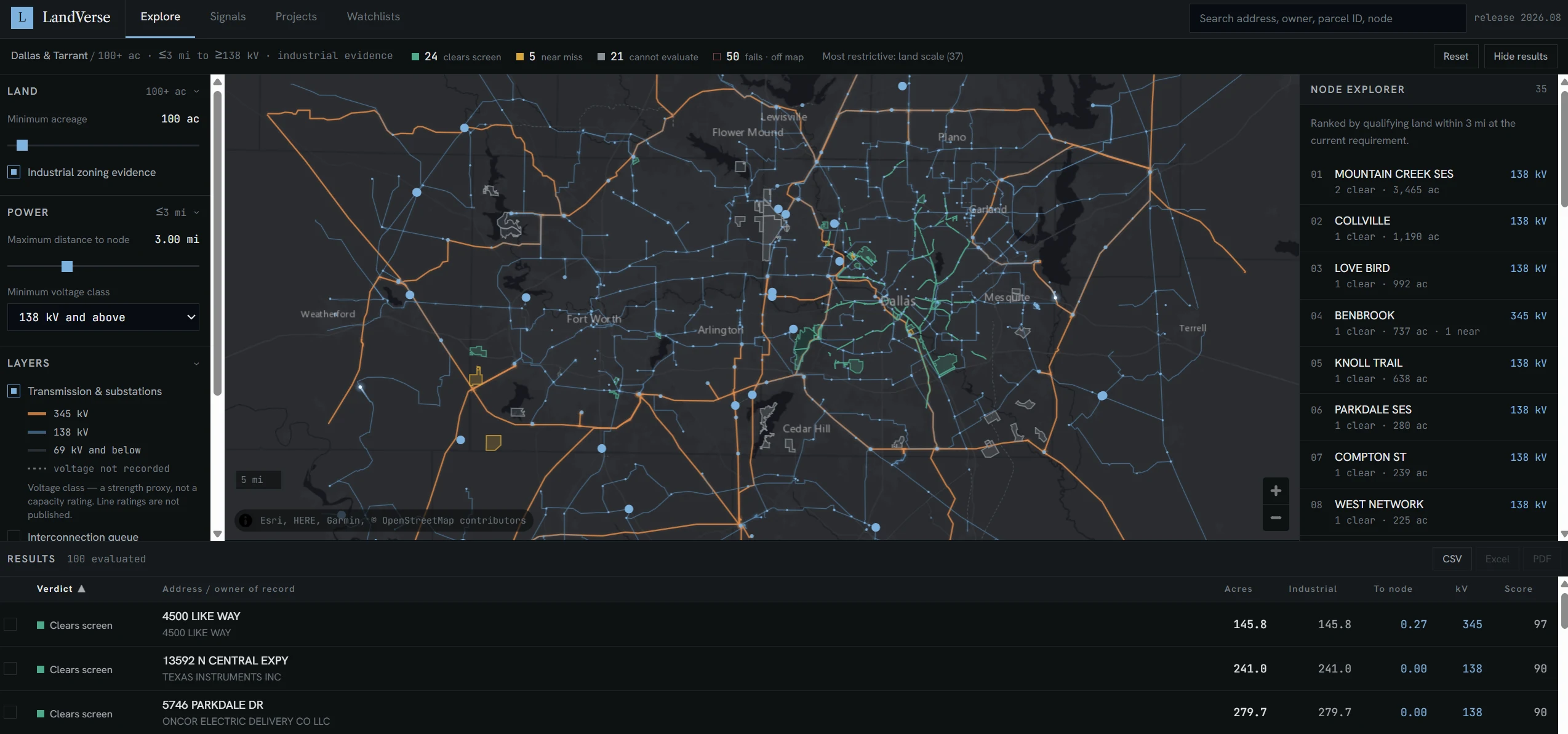
- Clears initial screenNorth Tarrant candidate612 acres · 1.8 mi to 345 kV · 487 industrial acresWetlands: not held84
- Near missWest corridor candidate352 acres · 0.7 mi to 345 kV · industrialFails land threshold by 48 acres78
- Insufficient evidenceSargent Road tract419 acres · 2.1 mi to 138 kVZoning coverage not held for this location—
Clears the acreage, zoning-evidence and power-proximity criteria. Deliverable capacity, water and flood conditions require separate validation.
226 county parcel systems and 100 municipal zoning layers.
226 of 254 Texas counties — 98.5% of Texans.
Every Texas county, registered before ground breaks.
Voltage class and line count, national.
Measured, not quoted
Acreage comes from geometry reprojected to EPSG:3083, never from a stated area. On one traced parcel the county’s own area field reads 41.7% high.
Absence is a value
An unmapped constraint renders as not held, never as clear. A zero where nobody looked is how a buyer ends up with land they cannot build on.
Proxies say so
Substation capacity is not published by any public source. So we report voltage class and line count as a node-strength proxy, and never print an available-megawatts figure we cannot stand behind.
The same calculation, entered from either end.
I need a site
Start from the grid, not the listings.
State a load and a deadline. See which nodes can be reached, which land sits inside them, and — for everything that does not qualify — the specific condition that ruled it out, with the number behind it.
Open the mapI have land
Find out what a buyer would see.
Enter an address or parcel number. Get your acreage, the nearest high-voltage infrastructure and its voltage class — then the full report on what would hold the site back, and what records do not exist for it.
Check a propertyOne briefing a month, built from the release.
Where large-project activity moved, which corridors it moved toward, and what the land around them looks like. No capacity claims we cannot source.